Hannah Stacked Bin System
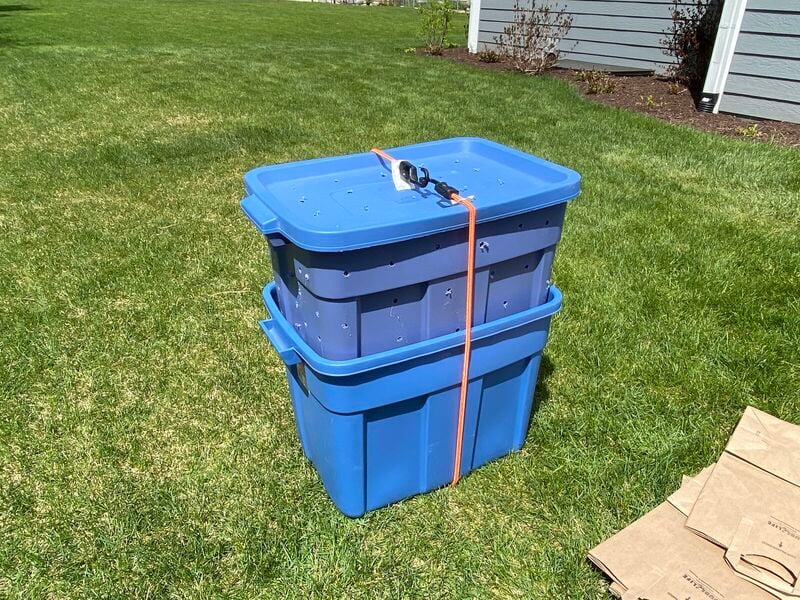
A two-bin home compost system made from storage bins and cans.
Source: https://www.appropedia.org/Hannah_Stacked_bin_system. Original author: User:Hcantrell · CC-BY-SA-4.0.
- Estimated cost
- $42.48
- Parts
- 5
- Tools
- 1
- Time
- A day
- Household size
- 2 people
- Storage bins
- 18 gallon
- Drill bit
- 5/16 in
- Hole spacing
- 2-3 inches apart
- Total stated in source
- $36.00
Summary
I created a compost system for a 2 person household in Williams Bay, Wisconsin. I wanted the system to be simple, easy to use and made from things around the home. The upkeep of this system is straightforward.
In this household there are 2 people who accumulate a fair amount of green waste and yard trimmings along with food scraps from the kitchen. One major concern was deer being able to access the bin, and a want was for quick compost turnover with ease. This was the reasoning for the 2 bin method that would not only insulate but allow for airflow to get to the compost from all corners.
Design criteria
| Criteria | Constraints | Weight (1-10) |
|---|---|---|
| Accessibility | System should be easily built and used by anyone in the household. It also should be hassle free to clean, turn and move around the yard. | 9 |
| Functionality | Able to take in compost from a home that cooks often so has plenty of food scraps as well as garden and lawn waste. Stands up to midwest climate. Keeps food scraps away from deer and squirrels. | 10 |
| Appropriate | Use materials that were around the house as a quick daytime project and also materials that would otherwise be considered waste. Minimizes cost. | 10 |
| Move-ability | This system is not needed to last a long time but rather should be able to be deconstructed quickly in case of winter storms or discontinuing the project. | 8 |
Build steps
7
-
Design the system
Design your project and make adjustments for the materials you have access to.

Figure 1: First design drawing: stacked bin system -
Gather your materials
Gather your materials. This specific system required: a drill with a 5/16 drill bit (small holes are best), 2 storage bins, 1 lid, 8 cans taped/glued together end to end, 2 paper bags for insulation, 2 bungee cords to secure from pests such as deer and racoons.

Figure 2: Gather materials. -
Drill the aeration holes
Drill holes in one of the storage bins in all of the sides, bottom and lid all 2-3 inches apart.

Figure 3: Drill holes. -
Place the cans
Tape 4 pairs of the cans together end to end, place one pair in each corner of the bin without holes.

Figure 3: Place cans -
Add insulation
(Optional) Place torn paper bags in the bin between the cans. This is to insulate the system.

Figure 3: place insulation. -
Stack the bins
Place the empty bin with holes into the bin without holes on top of the cans and insulation.

Figure 3: Put the bins together. -
Secure the system
Secure the system with 2 bungee cords.
Figure 3: Secure system.